Direction Breakdown

You hear the clock ticking as you herd your kids toward the door. You have exactly five minutes to get out of the house to make it on time. When you look down at your oldest, you realize he doesn’t have his blue shoes on . . . even though you have told him several times where they are and what to do.
When you question him again, he points to a green pair in the hallway. “I found them!” he states proudly. You take a deep breath and text your friend that you might be late as you trudge back upstairs to search for them under his bed.
Here’s the thing:
You KNOW your child understands the difference between green and blue;
You KNOW he understands what the word “GET” means; and
You KNOW he is very well acquainted with his own bed -
So why does this happen?
As adults, we often give directions that seem simple to us but don’t always click just right with our kids. For children who are still learning language or who have difficulties with understanding, retaining, or organizing it, ONE direction is quite literally a mountain of information.
Let’s break it down.
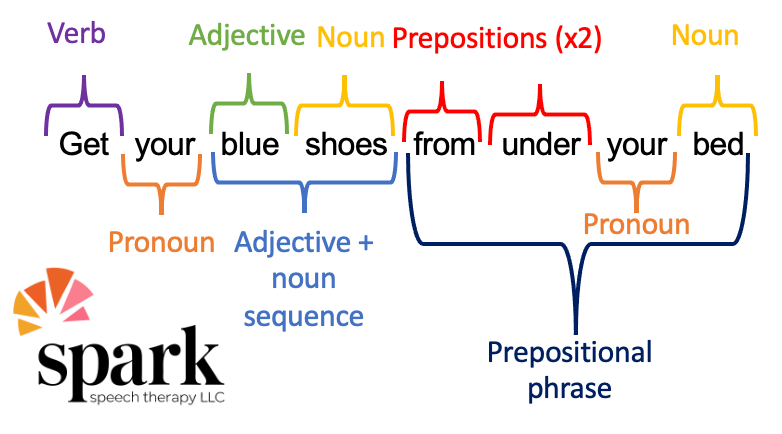
This ONE direction is actually composed of 10 distinct parts.
It requires your child to [at least partially] understand
Indirect language (you did not specify WHO was to get their shoes – rather, it was implied who you meant given context clues, facial expressions, and body language)
Predicate verbs
Possessive pronouns
Simple adjectives
Simple nouns
Prepositions
And have the processing and executive function skills in place to retain the:
Adjective + noun sequence and
Prepositional phrase
. . . Pair (+) that with a possibly dysregulated system from both parties due to being on a time crunch annnnd you have a recipe for misunderstanding.
So, what can we do to help?
In these moments—when you’re rushing or feeling stressed yourself—teaching and learning new concepts aren’t ideal.
Instead, try simplifying your language –
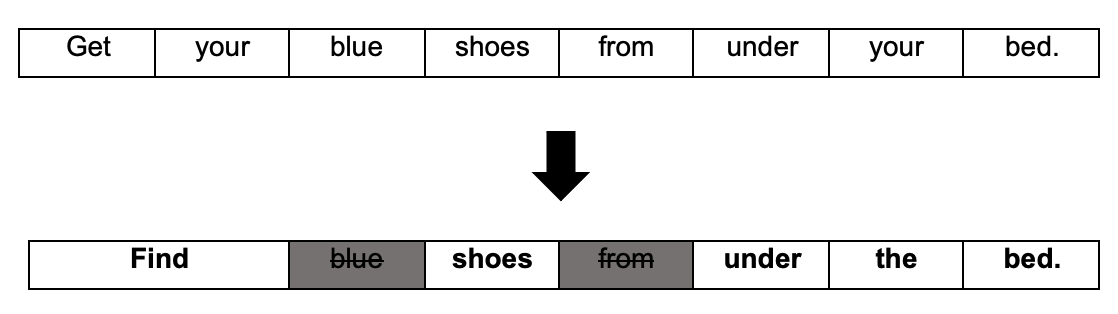
Paired (+) with pointing towards the desired location if your child has a hard time with spatial/preposition words.
→ After your child has completed the directive successfully, model/reinforce using the complete message:
“You found the shoes! They were under your bed.”
Notice how this reinforcement continues to break down the full message into two shorter, more manageable sentences.
Outside of these high pressure moments, find a place to practice receptive skills when time pressure is not a factor. This will help set your child up for much greater success next time!
Here are just a few examples of what you could try at home:
#1.) Help them break down the task into more manageable “chunks.”
“Go to your room.”
“See your bed?”
“Let’s look under it.” – giving a pointing prompt if your child is still learning location (preposition) words.
“Blue shoes! Where are you?”
“Found them!”
Verbally model/reinforce while pointing to the object and its location
“We found the blue shoes. They were under your bed!”
#2.) Make it visual.
Use visual schedules, pictures, pointing, and gesturing to your advantage.
Physically seeing the objects and actions paired (+) with spoken language can help with understanding and retention of verbal information.
#3.) Practice individual parts across fun and motivating activities.
For example, if “under” is a hard concept for your child to understand, consider:
Playing hide and seek but you can only hide UNDER something.
Playing pranks where one adult helps your child hide an item and another adult or sibling dramatically looks UNDER everything else except for that location -
Whilst continuously reinforcing the concept -
e.g., “Is it UNDER the chair? Nooo. Is it UNDER the table? Nooo.”
Incorporating UNDER actions into sensory games and obstacle courses.
Causing silly confusion by hiding dinner UNDER the plates.
#4.) Make it a [whole family] habit/routine to place everyday items (like shoes) in the same general location to decrease cognitive load during transitions.
Incorporate a collective box, mat, or designated room to hold them.
For younger children, color a favorite character’s shoes then tape the picture on the floor near the door.
Officially declare this the “Royal Shoe Spot.”
Remember:
Simplify,
Break down [chunk], and
Reinforce/model
If you suspect your child has difficulties with receptive language skills (understanding spoken words), reach out to a speech-language pathologist near you to tease out where the break down lies and to help create a more individualized treatment approach for them.
~~~
Do you live in McCordsville, Fishers, Fortville, Pendleton, Carmel, or a nearby location?
Feel free to reach out to Spark Speech Therapy LLC today for further support.
Disclaimer: The information shared in this post is intended for educational purposes only and is not a substitute for a comprehensive evaluation, diagnosis, or individualized treatment by a licensed speech-language pathologist.