Why are M&M’s Easier Than Blueberries?
Ultra-Processed Versus Naturally Occurring Foods
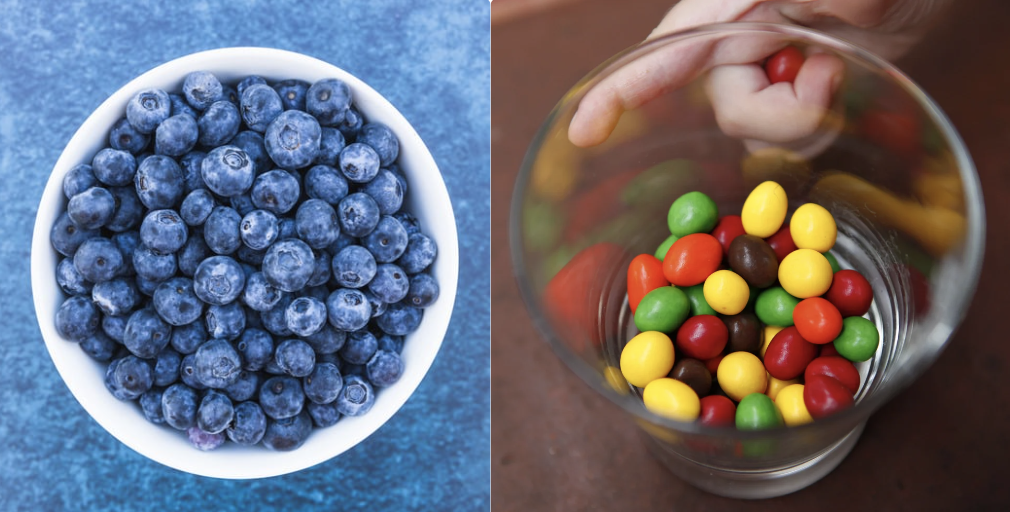
Both an M&M and a blueberry are similar sizes, and we’ve been told they taste sweet!
. . . So why is it so much harder to get your child to eat one over the other?
Many times, children who have a history of sensory or feeding difficulties have developed an overall mistrust in food for one reason or another. Perhaps they have had:
traumatic experiences with food (choking, intubation, hospitalization),
negative associations with eating (vomiting while eating a snack, repeated episodes of acid reflux that have paired eating with the sensation of pain and discomfort, chaotic or overstimulating eating environments, difficulty chewing or managing bites/swallows, etc.),
or any other internal or external experiences that could have impacted the delicate relationship with foods and mealtime.
This overall mistrust makes consistency all the more important.
For those who already have sensory aversions or baseline dysregulation – expected outcomes can feel vital to a pleasant meal or snack time experience.
So, let’s delve into the mind of an itty bitty –
You hand me a bag of sweets and my favorite chips - I can guarantee with near 100% certainty that this blue M&M will taste just like this red one; this red one will taste like this yellow one; and so on - just like I know this single Dorito chip will have a very similar taste as the next and the rest of the bag’s contents.
Same flavor, shape, crunch, overall mouth feel – I trust that these types of foods won’t change.
Now, reverse this scenario and pick up a blueberry (or a grape, or a slice of watermelon, etc.). This blueberry looks like the next one – they’re both cold, and round…but that’s where the similarities stop. While this blueberry “pops” in my mouth, the next one splats. These two are the same color but two different sizes. Not only that, but this one is sweet and this one is sour!
No longer do I have the reassurance that each bite will be the same. In fact, I can’t predict any of it at all! And that feels like a LOT for my body and mind to put together.
Suddenly, I’ve lost all trust in that particular food because what I felt or tasted was unexpected.
While processed food may not be the most nutritious choice, our kids know exactly what to expect every time, making it feel all the more enticing and their bodies all the more safe.
~ ~ ~
So, what can we do?
Next time you feel your frustration bubbling up at the table when your home cooked meal or those expensive berries are going untouched or, worse yet, causing a full-blown meltdown . . . take a moment to take a deep breath and regulate yourself however you need to – these moments are hard but not impossible. Recognize that what seems simple to you, may feel scary and overwhelming to your child.
In that moment, what they need the most is calm, comfort, and safety.
Instead of criticizing, try exploring. Instead of a “you must eat” approach – engage your child in curiosity through play, experiments, or discussion depending upon their age. Some things you could do include:
Naming what you see, feel, hear, and taste
Wow – this blueberry is HUGE!
Brrr – it’s cold on my arm AND my cheek. I wonder if it would still feel cold on my lips!
Model curiosity and/or direct interaction
It looks like a ball; I wonder if it bounces . . .
I bet I could roll it all the way down my arm!
Hmm – are my lips strong enough to blow it across my plate? Maybe it will move quicker with a straw!
Make it a game
Blueberry and strawberry Tic-Tac-Toe anyone?
I bet I can pop it from my mouth into that cup first!
HULK SMASH! (need I say more?)
For older kids, create charts to compare and contrast food features.
Create a “food scientist” log where they keep track of new or familiar food shapes, colors, textures, or tastes.
Explore and build curiosity without expectations or added pressure.
The more control our kids have in the process and the more they feel like part of the team, the easier it is to build confidence. While getting to the point of directly eating without fear or hesitation may take time and patience, the positive associations will give lasting security . . .
& suddenly, the unexpected moments
won’t feel quite as heavy or hard.
Disclaimer: The information shared in this post is intended for educational purposes only and is not a substitute for a comprehensive evaluation, diagnosis, or individualized treatment by a licensed speech-language pathologist.